


 Listen Live

Chicago, IL (CAPITOL NEWS ILLINOIS) – President Donald Trump’s “One Big Beautiful Bill” severely impacted two of Illinois’ most economically vulnerable groups: the hundreds of thousands of Illinoisans set to lose Supplemental Nutrition Assistance Program food assistance this year and the small farmers who are losing them as customers.
The bill, H.R. 1, made changes in who can receive SNAP benefits and went into effect this spring. The federal law expanded work requirements to previously exempt groups and eliminated benefits for lawfully present immigrants living in the U.S. under humanitarian protections, such as asylees, human trafficking survivors and refugees. The governor’s office estimated that 360,000 Illinoisans will lose benefits due to these changes.
Beginning Oct. 1, H.R. 1 will shift 25% more administrative expenses to the state, which will cost Illinois an estimated $80 million more annually. It also eliminated funding for SNAP-Ed, a nutrition education program that partnered with organizations throughout the state to heighten awareness of healthy food options.
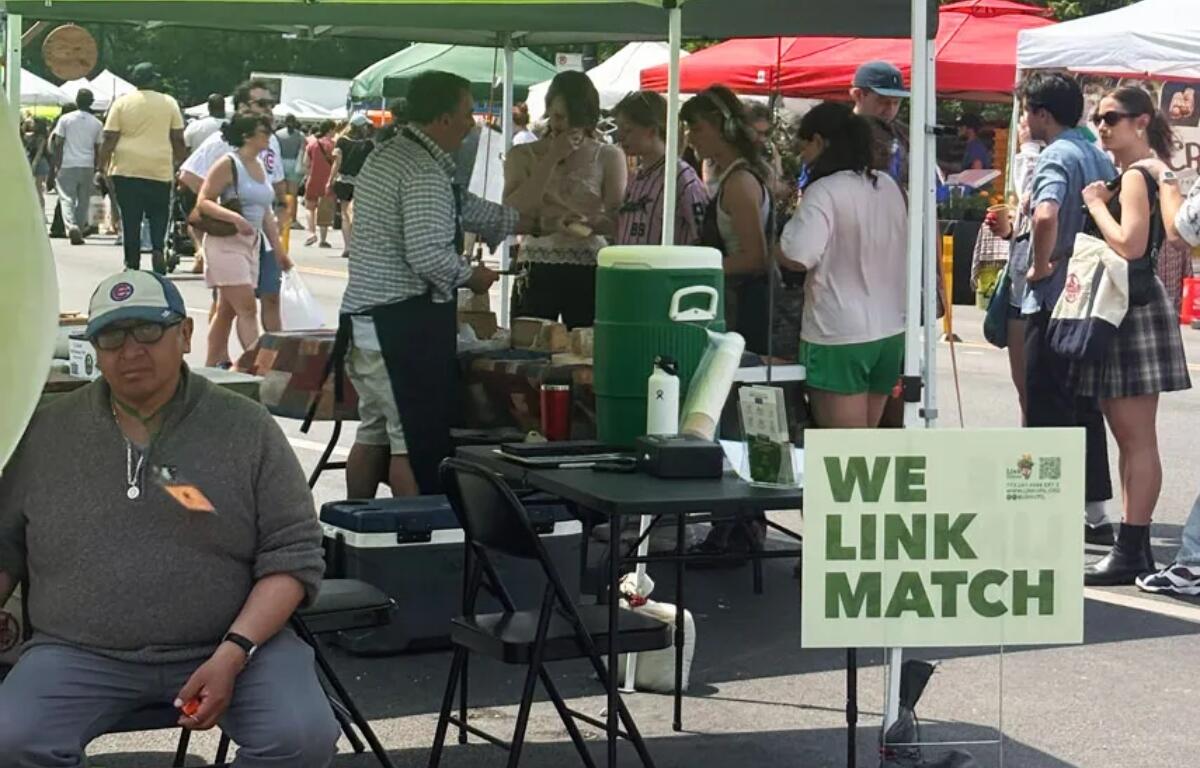
Among the programs SNAP-Ed connected Illinoisans to is Link Match, which allows SNAP recipients to purchase locally grown food from farmers markets, small grocers, food co-ops, farm stands and community supported agriculture (CSA) subscription services.
Link Match doubles SNAP users’ purchasing power by matching spending dollar for dollar. Experimental Station administers most of the state’s Link Match initiatives, offering Link Match at 157 grocers, food stands, farmers markets and other farm-to-consumer operations throughout Illinois.
Matthew Ruffi, who oversees Experimental Station’s Link Match program, said that Link Match is automatically available to anyone on SNAP benefits. SNAP users can swipe their EBT cards at a farmers market Link Match station or in one of the markets or co-ops that work with the program to receive vouchers for food or seeds and plants that will be used to produce food.
“Link Match is one of the best ways for someone who’s working with limited resources to access some of the freshest, healthiest food,” said Reese Amxy, a policy organizer at the Illinois Stewardship Alliance. “So if you’re parents of young children, you’re pregnant, you’re an elder, you’re struggling with some health challenges, this is the best option for you to get this really healthy, nutrient-dense food.”
Amyx said that because SNAP Link Match is primarily dedicated to food purchases from local producers, it is guaranteed money in the pockets of Illinois farmers, especially farmers for whom much of their yearly incomes are earned from May to October when summer farmers markets are operational.
Nationally, SNAP spending at farmers markets has grown steadily over the years, spiking during the COVID-19 pandemic when the SNAP Emergency Allotment boosted benefits for all recipients. The growth remained steady after the pandemic, rising from nearly $33.3 million in 2021 to $49.8 million in 2024 according to U.S. Department of Agriculture data.
If fewer people are able to use SNAP benefits, these numbers will likely shrink, meaning less money will go to small Illinois farmers, many of whom already exist on slim profit margins.
“The main place where a small Illinois-based farmer actually gets food to their customers is either at a farmer’s market or in a locally run grocer,” Amyx said. “That dollar amount would be unimpressive if we walked into the legislature — like $40,000 a year. That might be easily shrugged off. But to that farmer, it’s about whether their operation exists or not.”
Effects on Illinois farming
With 75% of the state’s land dedicated to farming, Illinois is one of the leading agricultural producers in the country, typically ranking first or second nationally in the export of soybeans and corn and third in the export of all agricultural commodities.
Despite the state’s high agricultural output, only 5% of the food consumed in Illinois is produced here, according to the latest Illinois Food System Roadmap Task Force from June 2025. For example, Illinois grew more soybeans than any other state in 2025, harvesting more than 639 million bushels — well ahead of Iowa’s 595 million bushels and Minnesota’s 371 million bushels. But almost none of those brussels end up as food on Illinois plates.
Large food retailers often prefer to purchase food from farmers who can produce and transport at large scales, which reduces prices. Retailers also import otherwise seasonal food year-round from places without harsh Midwest winters.
Amyx said that even larger-scale Illinois farmers are often unable to compete with growers from out of state — or country. He pointed to Flamm’s Orchard, a sixth-generation farm in southern Illinois.
“They are a pretty large-scale operation, and they previously supplied apples to all the Walmarts in Illinois,” he said. “Then within the last few years, Walmart started importing apples from South America.”
Meanwhile, increased production expenses and declining commodity prices have reduced the profitability of farming nationwide, with inflation-adjusted net farm incomes expected to decrease by $4.1 billion, or 2.6%, in 2026 from the year prior, despite record government payouts.
Family farms, which make up 95% of all U.S. farms, incur the heaviest costs from these declines in profitability, according to the Modern Ag Alliance’s 2026 State of the American Farmer. As a result, small farmers oftentimes rely on off-farm income, according to the U.S. Department of Agriculture.
SNAP and Link Match
While overall farm productivity has declined, Link Match spending has increased from $469,000 in 2021 to $2.26 million in 2025, according to data collected by Experimental Station. Much of this spending occurs at the 97 farmers markets in the state that accept Link Match.
Jacquelyn Evers, executive director of The Land Connection, a nonprofit dedicated to supporting sustainable agriculture and local food systems, said how much farmers actually take home from Link Match spending varies by day, time of the season and product availability.
“Farmers have said at some markets 100% of their sales comes from SNAP and other times 0%,” she said. “One food business that serves our region receives $40,000 in SNAP/Link sales from shoppers in a year.”
SNAP sales may not make up a substantial portion of many of these farmers’ incomes, but Amyx said that farmers nonetheless welcome the extra dollars and the chance to give something back to the community.
“There’s a lot of mission-driven motivation,” he said. “A lot of them are also the farmers who sold into the Illinois Eats program, which is the program where the food banks are purchasing fresh food from farmers. There’s a lot of overlap with the farmers who said, ‘I really am doing this because I deeply believe that people deserve to eat healthier food.’”
Part of the mission of Sola Gratia Farm in Urbana is ensuring people have access to healthy, local food. In addition to selling produce at the Champaign-Urbana Farmers Market through community-supported agriculture, the farm donates a portion of all it grows to food pantries and soup kitchens and holds free markets in the summers. Mission and volunteer coordinator Sophie Rasmus said participating in Link Match was a no-brainer.
“It would be this beautiful thing if everybody could buy from local farmers,” she said. “If a big part of your mission is ensuring that people have access to the food they need, but also, you do need to make money, then Link Match is a great way to fulfill both of those needs.”
Rasmus said she noticed a dip in SNAP sales at the farmers market last fall during the government shutdown. At the same time, she said she noticed more people at the free markets they hold twice a week.
“We were less concerned about the money not coming in and more concerned about folks not getting the food that they need,” she said. “That was hard to watch.”
In La Harpe, Ill., at Rockin’ D on the Ridge, Cassandra DeJaynes has raised cattle and sold beef with her husband since 2021. Although the majority of the revenue for the ranch comes from shipping out of state, DeJaynes said she still wanted to provide food to her local community. She incorporated SNAP into their sales early on so their neighbors in Hancock County, which is among the poorest counties in the state, would have access to fresh, local beef.
“We knew coming into it, if we accept SNAP benefits, we will get more customers, and that has held true for us,” she said. “We have some very large families that take in foster kids, and we are their primary source of animal proteins. They’ll get a five-pound chuck, and then they’ve got enough to feed the whole family meatloaf.”
DeJaynes said that SNAP sales account for around 25% of the sales they make locally.
The future of SNAP
The Illinois General Assembly passed a nearly $56 billion budget on June 1, which was signed by Gov. JB Pritzker on June 16, that includes a one-time payment of $400 to families who will lose their SNAP benefits due to H.R. 1’s new work requirements.
It is too soon to tell how the H.R. 1 changes to SNAP will impact the amount of Link Match spending — or whether the extra $400 will mitigate any of that impact.
Farmers and organizers say the cuts put vulnerable Illinoisans and small farmers at increased risk at a time when many are stretching every dollar. Feed America estimates that one in six people are facing hunger in Illinois.
“Go look at how many neighbors you have in your building. One of them, if not more, are probably either on or very, very darn close to qualifying for SNAP benefits,” said Ruffi of Experimental Station’s Link Match program. “They’re a paycheck away from wondering whether they’re going to make rent, a couple paychecks away from wondering if they’re going to be able to feed themselves.”
Molly A. Wallace is a graduate student in journalism with Northwestern University’s Medill School of Journalism, Media and Integrated Marketing Communications, and is a fellow in its Medill Illinois News Bureau working in partnership with Capitol News Illinois.
Capitol News Illinois is a nonprofit, nonpartisan news service that distributes state government coverage to hundreds of news outlets statewide. It is funded primarily by the Illinois Press Foundation and the Robert R. McCormick Foundation.