


 Listen Live

Springfield, IL (CAPITOL NEWS ILLINOIS) – The debate over how to regulate data centers in Illinois is intensifying as lawmakers struggle to balance costs to consumers and the state’s need to be competitive economically.
Data centers house computer systems that store, process and distribute data but require large amounts of energy to power that workload. A growing number of these facilities are used to power AI.
A state report published in December projects energy shortfalls would begin in northern Illinois by 2029 and the rest of the state by 2031, driven in large part by data centers’ increased power usage. That’s led Gov. JB Pritzker to backtrack on a proposal he signed in his first year as governor to incentivize data center development in the state.
“With the shifting energy landscape, it is imperative that our growth does not undermine affordability and stability for our families,” he said, proposing a two-year moratorium on the incentives in his budget address Wednesday.
Illinois consumers blame data centers — which often receive generous tax incentives in Illinois — for straining the grid and driving up prices, and they want relief. But companies that operate the centers are seeking ways to build more quickly and pushing for looser regulation, arguing the centers are key to the state’s economic future.
And the state, from the governor’s office to the legislature, is struggling with ways to balance the economic interests tied to data center development with environmental and consumer cost concerns.
Read more: Lawmakers seek ways to prevent data centers from straining Illinois’ power grids
“We don’t want them to overwhelm our electrical capabilities and our water resources,” Sen. Steve Stadelman, D-Caledonia, said. “If we’re going to allow them and track them, how can we make sure it benefits Illinois residents and rate payers in the state?”
Data center negotiations continue
These are the same issues and tensions legislators hoped to address in their fall veto session. But no broad consensus was reached, and instead, Gov. JB Pritzker signed the Clean and Reliable Grid Affordability Act, adding new air regulations for backup generators used by data centers.
Lawmakers in Springfield have already begun negotiating a new round of data center regulations.
Sen. Ram Villivalam, D-Chicago, recently announced the introduction of Senate Bill 4016, known as the POWER Act, to place prohibitions on cost shifting, introduce “bring your own new clean capacity and energy,” guarantee transparent public engagement and implement water efficiency standards on data centers.
“By establishing policies that ensure data centers, not consumers, bear the increasing energy costs, and critical protections for our environment and sustainable water use, we can work toward a future built for technology to support our daily lives,” Villivalam said, “not deplete our resources and price us out of our homes.”
Read more: POWER Act: Lawmakers seek to regulate new data centers’ power, water usage | Pritzker touts Illinois’ economic development at data center groundbreaking
Environmentalists want new data centers to build their own renewable energy sources on site to prevent new projects from further stressing energy infrastructure and creating more pollution.
Pritzker said something similar earlier this month: “If they are, in any way, going to increase the price of electricity for consumers, they should pay for that increase, not the consumers.”.
The data center companies oppose such mandates, preferring a voluntary “bring your own energy” policy, according to Brad Tietz, director of state policy for the Data Center Coalition industry group.
“I think, ultimately, when you try to mandate something, you get less of it,” he said.
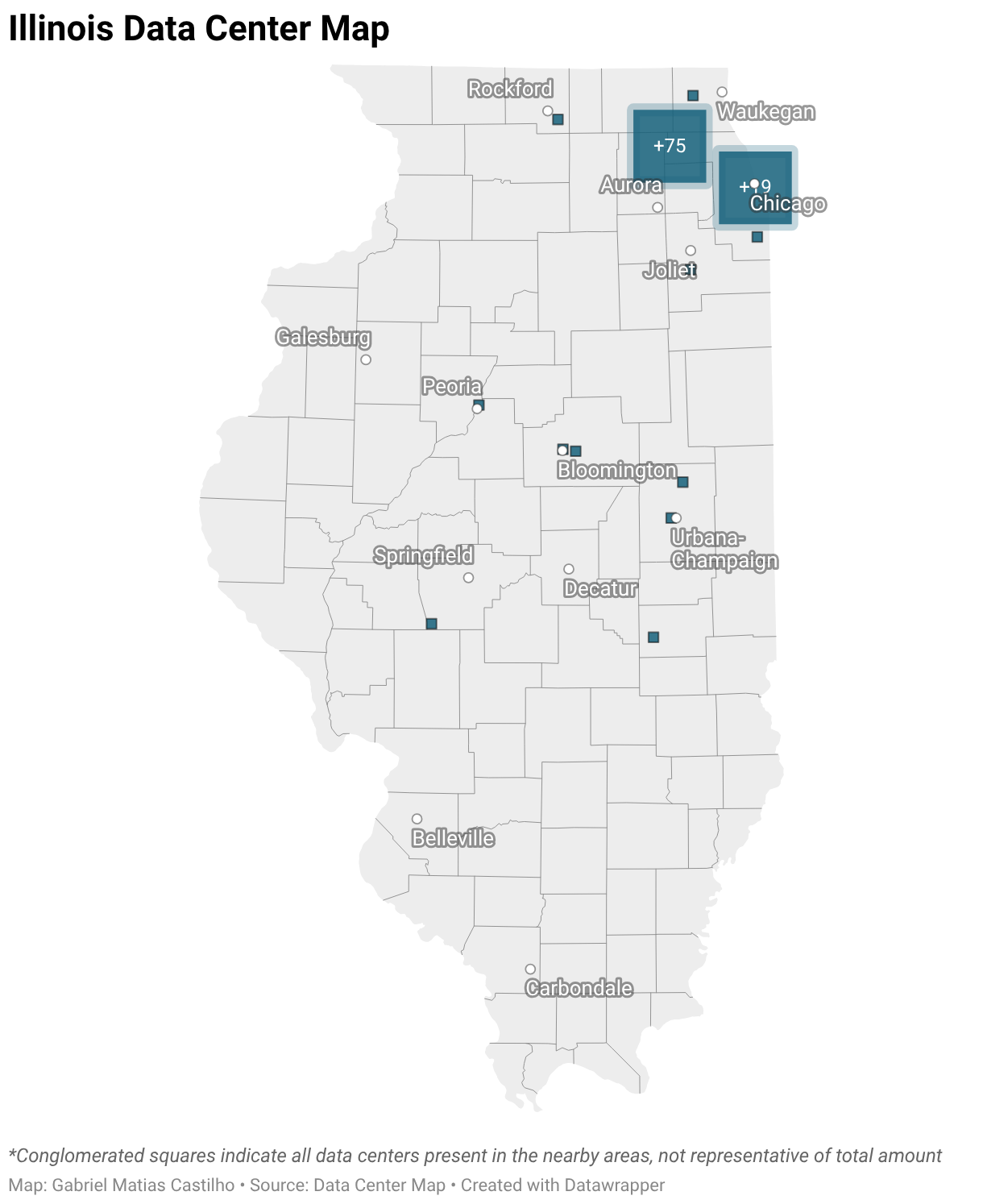
States are competing to attract investments from companies that want to build more data centers as they seek an edge in the artificial intelligence race. Illinois has the fourth-largest number of data centers — 222 — in the country, but Tietz said the state is in danger of slipping because other states have friendlier policies.
Illinois has provided tax incentives for data centers since Pritzker signed bipartisan legislation in 2019. According to the state’s 2024 report, at least 27 data centers had received incentives totaling $983 million in estimated lifetime tax breaks and benefits. That would stop for at least two years under Pritzker’s plan.
Read more: Pritzker signs major energy reform bill amid projected shortages | As energy bill continues to take shape, a key Senate architect plans to retire
Sen. Terri Bryant, R-Murphysboro, said she would like to see “a change in our policy here in Illinois” so the state does not fall behind, though she hopes those centers bring their own energy.
“We want to be able to do that because if we don’t, China will. If we don’t, Wisconsin will, Indiana will,” she said.
‘Little type of war’
As negotiations progress, the Data Center Coalition has signified another point of contention: A 2008 law known as the Biometric Information Privacy Act that prohibits private companies from collecting personal data without informed consent. The law allows people to sue over the misuse of their biometric profile, such as fingerprint mapping, facial recognition and retina scans.
Stadelman said the privacy protections in the act, which Illinois put in place before any other state, are at the center of a “little type of war.”
Read more: Illinois Senate advances changes to state’s biometric privacy law after business groups split
“You have privacy rights advocates saying, ‘We’re a leader in the country as far as protecting people’s privacy rights and protecting their data,’” Stadelman said. “But the data (centers) say, ‘We’re not going to have more projects in Illinois unless you change the BIPA legislation.’”
Tietz said these regulations have factored into operators’ decisions to bypass Illinois, although lawmakers in 2024 drastically curtailed the way damages accrue and the liability private entities are likely to face if found in violation.
Read more: Judge dismisses biometric data privacy lawsuit citing revised state law
But the data center industry wasn’t satisfied, and its leaders say the legal liabilities are one reason they are building in other states.
Abe Scarr, state director of the Illinois Public Interest Research Group, said biometric information is uniquely sensitive.
“We should know who is collecting and commercializing information created from the stuff our lives are made of,” Scarr said. “And we should have to opt into — and be able to easily opt out of — pervasive, intrusive surveillance.”
Consumer backlash
The legislative debate comes as data centers have become increasingly controversial. In January, the Aurora City Council approved a moratorium pausing new data centers. The city had five data centers in development and had been receiving requests to build more even as residents and environmental groups complained about noise, water usage and rising utility costs.
Alison Lindburg, director of sustainability for Aurora, said the city passed the moratorium because it needed time to put requirements for data centers in place.
“We have tried to explain that to communities, that it’s not just about data centers in Aurora, it’s about the entire grid, but that doesn’t matter to them,” Lindburg said in an interview. “I think they’re just very frustrated overall with the rising electricity prices.”
Read more: With electricity price spikes coming, environmental and industry groups pitch reform | As state regulators warn of impending energy shortfalls, capacity prices rise again
Hannah Flath, Illinois Environmental Council’s climate communications director, said other communities are also opposing data centers.
“In that case (Aurora), the local government acted in accordance with what their local constituents were saying,” Flath said.
Tietz said he has been in conversations with officials from Aurora about the 180-day moratorium and is hoping he can help find a solution.
Lucy Contreras, GreenLatinos Illinois state program director, said communities should have a voice in whether, where and how these projects are built. She said developers must ensure host communities receive tangible benefits rather than bearing only the burdens of hosting these facilities.
“They contribute to air pollution and consume excessive amounts of water daily, which restrains local water systems that might already be struggling,” Contreras said. “Without strong and forceful regulations, data center expansion will deepen existing inequalities, harm public health and undermine our Illinois clean energy goals.”
Spreading the costs
Utilities are building billions of dollars of new power lines and plants to keep up with energy demand increases brought on by data centers — whether they’re built or in the process of being built. They, in turn, spread associated costs to ratepayers.
“Speculation about data center development has actually increased prices,” Sen. Bill Cunningham, D-Chicago, said. “It’s not just the immediate demand, it’s anticipated future demand, so it’s really important to sift out the wheat from the chaff on what’s a real proposal and what isn’t.”
Cunningham said he expects fellow Democratic lawmakers to work on safeguards for consumers when pending data center projects go uncompleted.
Recently, northern Illinois utility Commonwealth Edison announced it will require a 10-year guarantee of revenues upfront from big energy consumers. ComEd said this will help protect ratepayers from bearing the costs of high-load projects and ensure, even if they don’t come to fruition.
Maddie Wazowicz, Midwest Energy Efficiency Alliance policy director, said utilities function best when they can plan into the future.
“Whether or not data centers emerge — and how much, how many of them come, where and how long they last — does complicate utility long-term planning,” she said.
Gabriel Castilho is a graduate student in journalism with Northwestern University’s Medill School of Journalism, Media and Integrated Marketing Communications, and is a fellow in its Medill Illinois News Bureau working in partnership with Capitol News Illinois.
Capitol News Illinois is a nonprofit, nonpartisan news service that distributes state government coverage to hundreds of news outlets statewide. It is funded primarily by the Illinois Press Foundation and the Robert R. McCormick Foundation.