


 Listen Live
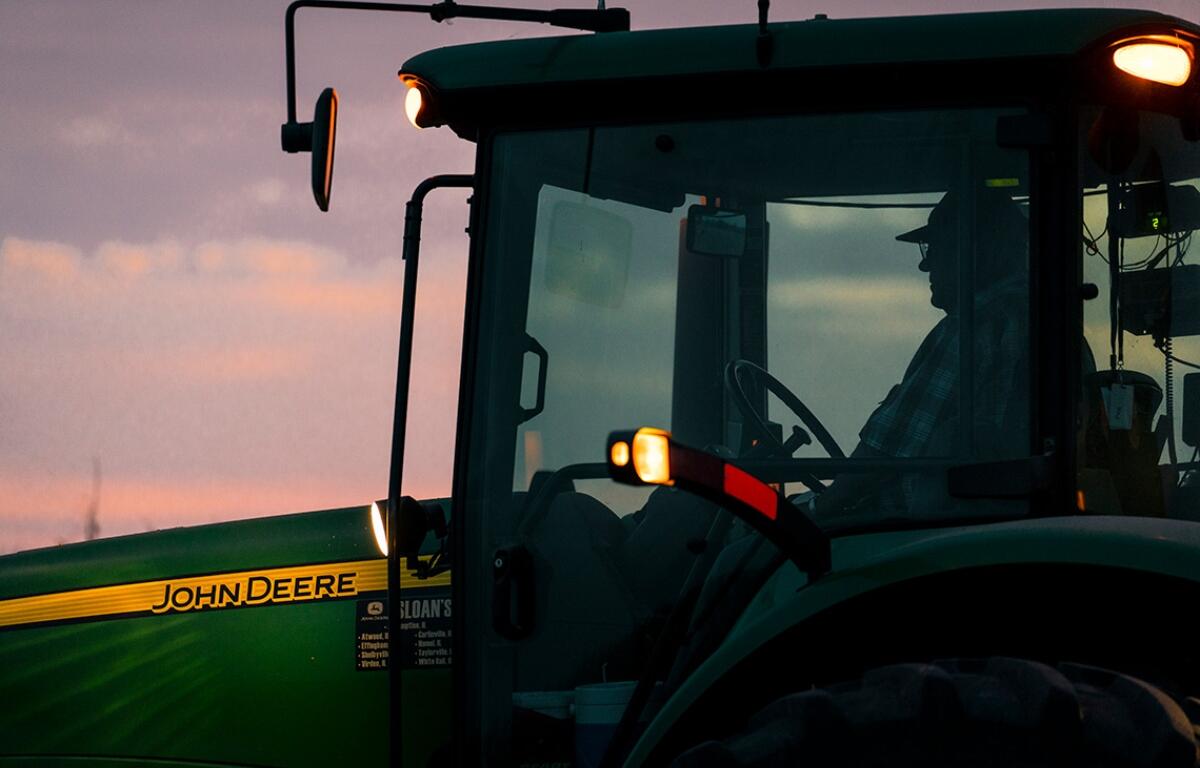

(CAPITOL NEWS ILLINOIS) – Brock Seymour was 5 the first time he drove a combine. It was pouring rain, and his grandfather had jumped out to fetch the grain cart, leaving him to drive across the field.
“I’ll never forget that,” Seymour said. “When he got down out of the combine, he said, ‘Just drive straight, buddy.’”
From that point on, Seymour knew he wanted to be a farmer. Growing up on the family farm in Shipman, Illinois, Seymour took on responsibility early, helping with operations at 13 and by his early 20s, learning the business side of running a farm.
Now 26, he represents the fifth generation on his family’s land. With his grandparents entering their late 70s, those responsibilities are shifting into conversations about succession.
His path is a familiar one for young farmers in Illinois, many of them fifth- or sixth-generation stewards of Midwestern farms. Yet, less than 9% of Illinois farmers are below the age of 35, and the average age of a farmer in Illinois is over 58, according to the U.S. Department of Agriculture’s 2022 agriculture census.
If you ask farmers why that is, the reasons for the stats are varied. For any young farmer, not least those without access to inherited land, there are the high costs of getting started. This includes land, equipment and fertilizer, none of which are cheap.
For those looking to continue their family legacy, there is a hefty estate tax associated with taking over the business and the land. But there’s also a sense of some in the older generation not wanting to pass the torch, and because of improved equipment quality, they don’t have to just yet.
While the U.S. Department of Agriculture has programs in place to support young farmers, including low-interest loans; the threshold to entry remains high, said Garrett Williams, 26, chair of the Illinois Farm Bureau’s young leader committee.
“I do think that the rising costs of inputs and the buy-in on assets and ground is probably a relatively high barrier,” Williams said. “For young farmers, especially those with families, it can be a challenge.”
Farming is capital-intensive; there are equipment costs, fertilizer costs, and the price of land and labor. A combine alone can cost more than $1 million. Tariffs and geopolitical disruptions have already increased costs for Illinois farmers in recent years, according to the Illinois Soybean Association. Now, conflict in the Middle East is adding new pressures, with fertilizer prices at risk of climbing toward levels not seen since Russia’s 2022 invasion of Ukraine, which also upended global supply chains.
Read more: Illinois soybean farmers welcome federal aid, but fear long-term trade damage
“People just don’t realize how much money it takes to start from scratch,” said Lance Muirhead, a seventh-generation corn and soybean farmer in Cerro Gordo, Illinois. “If you don’t have some kind of financial backing, it’s extremely expensive to be a farmer.”
Even if you are fortunate enough as a young farmer to inherit farmland from your parents or grandparents, the financial burdens remain through taxation, Muirhead, 29, said.
‘Land rich and cash poor’
Illinois is one of a dozen states that imposes a so-called “death tax” — a state-level estate tax on inherited assets, separate from federal taxes. While Congress raised the federal estate-tax exemption to $15 million through the One Big Beautiful Bill Act, farmers in Illinois still face state-level taxes if they reach the $4 million threshold. That means that once an estate exceeds $4 million, the entire value is subject to taxation.
With land and equipment becoming more valuable, it’s easy to reach that $4 million limit, Williams said.
The Family Farm Preservation Act, which would have raised the estate tax threshold to $6 million, included key priorities for the Illinois Farm Bureau. The measure would allow for the 96% of farms that are family owned to stay intact when passed down between generations, without having to sell off land or assets, according to the farm bureau.
“Farmers, we have a tendency to be land rich and cash poor,” Williams said. “I think that’s the general sentiment. Any taxes incurred on inherited assets can be very difficult. It can be cumbersome on the young farmer to come up with that cash to keep those acres and keep that equipment for the operation.”
The prices of both land and equipment have risen for farmers over the past decade, increasing the value of estates.
“You know, the price of land has skyrocketed,” Muirhead said. “I see a lot of family farms that could be passed down to the next generation. But once they’re inherited, they have to go pay all this tax and sell two-thirds of the farm to be able to keep one-third in the family. And that’s just not right.”
The Family Farm Preservation Act (contained in Senate Bill 2921 and House Bill 4600) did not pass the previous legislative session due to fiscal concerns over reducing state revenue while trying to resolve a budget deficit. Now, a new bill, Senate Bill 1688, is currently awaiting assignment to a Senate committee. Sponsored by Sen. Doris Turner, D-Springfield, who chairs the Senate Agriculture Committee, the bill seeks to raise the tax exemption to $6 million.
Turner echoed fiscal concerns about lost revenue for the state, saying “It’s the money. That’s the big piece.”
However, she hopes this time there is enough momentum for the bill to pass. It’s been awaiting a committee assignment since February 2025.
“We’re working really hard with all of the stakeholders,” Turner said. “Hopefully we get it over the finish line.”
Sen. Terri Bryant, R-Murphysboro, is among 29 cosponsors on the bill, which has bipartisan support in both the House and Senate.
“You can get to $4 million really fast when a combine costs $1 million,” Bryant said. “So we need to get rid of that and bring it in line with the federal government. We’re pushing for it really hard.”
“I don’t know anyone who is against it,” added Sen. Sally Turner, R-Beason.
Estate tax revenues have “increased significantly in recent years,” according to a January Commission on Government Forecasting and Accountability report. Between fiscal year 2012 and fiscal year 2020, receipts averaged more than $300 million annually. And in recent years, they’ve gone north of $600 million. Some growth can be attributed to a sharp rise in asset valuations.
Gov. JB Pritzker said in March that changes to the estate tax have not been a priority, though he added: “I do think it’s something that I could support as long as it includes the kind of tax break that I think is appropriate to preserving small farms and small businesses.”
“I think there are people who look at me and think (an) estate tax cut is not something that Pritzker should be the advocate for,” Pritzker said, acknowledging his billionaire status. “But I understand, very much so, how impactful it is in a negative way on farmers and on small businesspeople.”
The combined impact of high costs and estate taxes can lead young farmers to delay formally buying into the family farm until they have gained enough capital. As a result, these transitions often happen later in life, according to the University of Illinois’ farmdoc daily, a website that offers research-based analysis for farmers, market analysts, policymakers and more.
A reluctance to step aside
Financial barriers are only part of the challenge facing new farmers. While agriculture has long required significant capital, some experts say older farmers are holding onto their operations longer, leaving fewer opportunities for the next generation.
Kevin Brooks, a farm management commercial agriculture educator with University of Illinois Extension, said transitions within family farms can be difficult to navigate, leading some to delay succession planning altogether.
“A lot of fathers that are running on farms don’t want to give up that control,” Brooks said. “People don’t like to talk about their impending demise. They don’t want to talk about slowing down and retiring. There’s that work ethic of wanting to stay at it.”
This puts younger farmers in a bind, having to play the waiting game until the older generation is ready to pass the torch, said Seymour, the Shipman farmer.
“Maybe when I get that age, I’ll be the same way. I don’t know,” Seymour said. “I can’t speak for the older generation, but they’ve put blood, sweat and tears into the ground. And I think they just have a hard time being able to hang them up and, you know, smoothly pass it on.”
In recent decades, farming equipment has gotten considerably more advanced, making it more comfortable to farm and less demanding physically. This has allowed people to stick with it longer, Brooks said.
“To an extent, the boomer generation hung on for a long time. And I don’t blame them. They get a bad rap,” said Muirhead, the Cerro Gordo farmer. “They went out in open-air cab tractors and farmed with four-row planters. Then they got better equipment, air conditioning, air ride suspension, and auto steer. They put in the work, and they get to reap the benefits of that. I don’t blame them.”
Last year, the Farmland Transition Commission Act, Senate Bill 2372, was signed into law, creating a new body within the Illinois Department of Agriculture tasked with reviewing the barriers to acquiring farmland for people aged 25 to 40. It was championed by Sen. Sally Turner. As part of the act, she is working with the state agriculture department to create a webpage where younger people can get useful information on entering farming.
“Young farmers see all the roadblocks,” Turner said. “From problems with tariffs, the low prices of corn and beans, and everything on top of it. But there’s different avenues that can help you as a farmer, like low-interest loans if you wanted to try and buy a piece of ground. All those things are out there.”
For young farmers in Illinois, the challenges are hard to ignore, including longer term concerns about South American competition impacting soybean farmers in the state. But knowing that previous generations have overcome similar obstacles instills confidence.
“To see anybody struggle, it’s not encouraging, but to see them get through it has the opposite effect,” Muirhead said. “If you work hard enough or smart enough, you’ll get through the bad times.”
Brock Seymour has been working full time at his family farm for the past few years. The estate tax concerns him, and lifting the threshold would give him and his family more breathing room, he said. As with any family business, navigating succession planning and generational divides can be challenging, but Seymour is optimistic about the future.
“Now there’s hard times. I’m not going to lie,” Seymour said. “As a farmer, you know, you’re gambling. But to see how Grandpa has built the foundation gives me confidence that I can do the same.”
Rebecka Pieder is a graduate student in journalism with Northwestern University’s Medill School of Journalism, Media and Integrated Marketing Communications, and is a fellow in its Medill Illinois News Bureau working in partnership with Capitol News Illinois.
Capitol News Illinois is a nonprofit, nonpartisan news service that distributes state government coverage to hundreds of news outlets statewide. It is funded primarily by the Illinois Press Foundation and the Robert R. McCormick Foundation.