


 Listen Live
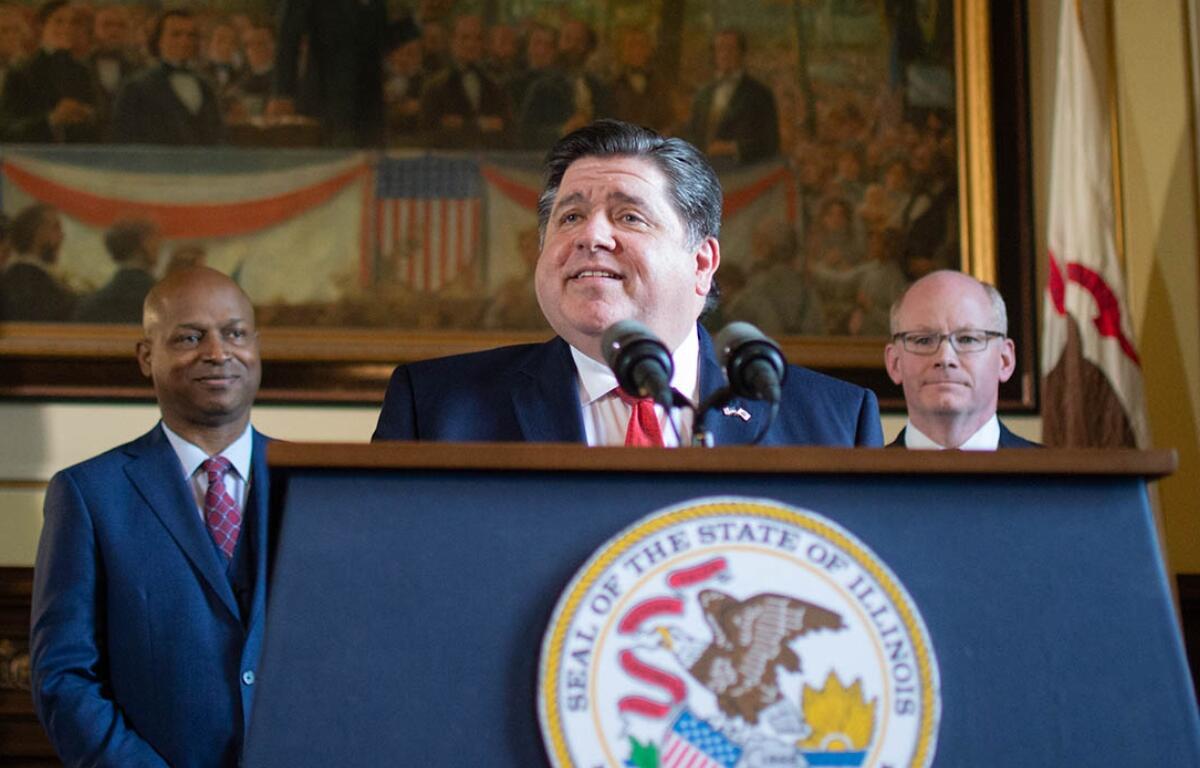

Springfield, IL (CAPITOL NEWS ILLINOIS) – Violent protests, legally questionable immigration raids and the deployment of National Guard troops without the governor’s approval will be at the forefront of state lawmakers’ minds when they return to Springfield on Tuesday.
“Lawyers in my office are researching other things that we can do” about the federal government’s aggressive tactics, House Speaker Chris Welch, D-Hillside, said in an interview with Capitol News Illinois. “We are going to be having some conversations here in the next couple of days to see if there are some things in the veto session that we can get done.”
The General Assembly convenes for the annual fall veto session for three days this week followed by another three days on Oct. 28-30. Lawmakers’ to-do list was already hefty with several issues, including public transportation and energy reform, which were left unresolved in the spring.
But Welch said lawmakers can’t ignore what’s happening at the federal level in Chicago.
His near-west suburban district includes Broadview, where an immigration processing center has become a flash point for clashes between federal agents and protesters.
While he said lawyers are exploring options, leaders acknowledged the Supremacy Clause of the U.S. Constitution limits a state’s ability to regulate the federal government’s actions.
“There are limitations on what we can do, which is frustrating, especially when it feels like the federal government is attacking Illinois,” Senate President Don Harmon, D-Oak Park, told Capitol News Illinois.
Big Beautiful Bill Act
President Donald Trump also signed a domestic policy plan over the summer with wide-ranging implications on the state budget and social service programs in Illinois.
While programs like Medicaid face cuts in the coming years, the state could see decreased revenue returns because parts of the state’s tax code are tied to the federal code. Welch said it’s possible lawmakers will find ways to decouple from federal tax policies.
Read more: Illinois on track for deficit as new federal policies create challenges
“We hope it would minimize some of the damage that this bill is doing to states like Illinois,” he said of the so-called One Big Beautiful Bill Act.
However, the leaders tamped down expectations that this month will yield several big policy initiatives.
“I often remind people that the veto session is six days, not six months, and people who go in with an exaggerated sense of what we can do are most often disappointed,” Harmon said.
Here are some of the issues lawmakers will be grappling with this month:
Transit reform
Saving the Chicago-area transit agencies from having to enact massive service cuts is a top priority for lawmakers this month — though Welch and Harmon both left room for the possibility that it gets pushed to the spring.
“I’m hopeful that we’re going to get something done in the veto session that will address this issue,” Welch said. “If not in veto session, then the regular session.”
Harmon indicated the path forward requires the House to accept or counter a plan passed by the Senate in May. That plan passed just before midnight on the final session day, leaving the House almost no time to consider the measure that contained a controversial $1.50 per-package statewide delivery fee.
“If the House is ready to have that conversation in the fall, we’d happily engage,” Harmon said. “If the House would like to wait until the new year, we’ll roll with the punches.”
Read more: Lawmakers ‘ready to move’ on transit reform, but funding agreement remains elusive
The issue lost some urgency when the Regional Transportation Authority released new estimates on Oct. 3 that the Chicago Transit Authority won’t face a funding shortfall until the middle of 2026. Per the new estimate, the four Chicago-area transit agencies — CTA, RTA, Pace and Metra — collectively will be short $202 million next year. That’s down from a $771 million shortfall that lawmakers were projecting during the spring.
Because of that, lawmakers theoretically don’t have to pass a reform plan this fall, though the transit agencies approve their budgets in December. That means they will have to plan for the shortfalls in short order, such as by approving cuts or fare hikes, if lawmakers don’t approve new funding.
Lawmakers are still working to reach an agreement about how to fund public transportation and what new sources of revenue — likely tax increases — can receive enough votes.
‘Da Bears’ stadium
The Chicago Bears are committed to building a stadium in Arlington Heights, but the organization says a “megaproject” bill in Springfield is necessary to close the deal. The bill would allow large developments, like what the Bears are proposing, to have property tax assessments frozen so that construction costs don’t raise the property’s value for several years.
Asked about the prospects of the bill passing during the two-week-long veto session, Harmon said the Bears should consider it a “bye week.”
“I am most concerned about the health and ability of their offensive tackles,” Harmon said.
Many Chicago lawmakers, which make up a sizable portion of legislative Democrats, are opposed to the Bears leaving the city. Gov. JB Pritzker also wants the Bears to pay off the remaining $534 million debt from 2003 renovations at Soldier Field that’s held by the Illinois Sports Facilities Authority.
“We need to make sure that the taxpayers are not burdened by the debt that was put on in the building of the stadium if we’re then going to go on and support more funding for anything to do with the next stadium,” Pritzker said last month.
The Bears plan to privately fund the stadium on the former Arlington Park property but are seeking $855 million in public funding for infrastructure at the site, according to an economic impact report released by the team on Sept. 30. The Bears are seeking state financial help in upgrading area roads and the Metra line that stops at the property. In return, the reports estimated the state could bring in $43 million in annual gross revenue from various state taxes.
The Bears have said they hope to begin construction this year but are just beginning their formal pitch to Arlington Heights officials.
Energy reform
Customers of Ameren and Commonwealth Edison, the state’s largest electric utilities, saw unusually high prices on their monthly bills throughout the summer. Electric markets around the country have been responding to the first major increase in electric demand in a generation, largely thanks to data centers — large computing facilities that require huge amounts of electricity 24/7.
Since late 2024, state lawmakers have been debating how the state should respond to the increased demand and prices. Lawmakers who are part of the negotiations have signaled for weeks that they are nearing a deal for veto session, though things can change quickly in Springfield.
Read more: Nuclear power, battery storage funding at center of energy policy debate | As energy bill continues to take shape, a key Senate architect plans to retire
The bill will likely include expanded incentives for battery storage technology — a major priority for the solar industry — as well as tighter rules around energy efficiency programs at electric utilities and new regulations on how utilities incorporate distributed resources like rooftop solar projects onto the grid.
Welch said he is “hopeful” that lawmakers can reach an agreement. Harmon said he is concerned that incentive programs and other parts of the bill may increase customer costs in the short-term, even if there are long-term savings.
The biggest unknown for the bill is whether it will include direct regulations on data centers’ use of electricity, something Welch said is possible. Environmentalists and several lawmakers have pushed for a longer debate over the issue next year, but business groups have made moves to loosen a data privacy law as part of negotiations over the energy bill.
“Sometimes they can get too big and that’s what kills it, so hopefully we can get it just right and get something done,” Welch said. “If not, it’s probably going to have to be something that carries over into the spring.”
Insurance regulation
Pritzker, Welch and Harmon published a letter in the Tribune in July criticizing State Farm for increasing home insurance rates in Illinois. The leaders called on lawmakers to increase regulations and oversight on insurance rates.
The Bloomington-based company raised premiums in July for Illinois homeowners by 27.2%, citing growing losses the company is taking from severe weather claims. The trio said State Farm was not transparent about the reason for the increase.
Read more: State leaders seek more transparency from insurance companies
The leaders said Illinois should be like other states and give the Illinois Department of Insurance authority to review rate increases to determine whether they are fair or necessary.
Welch again said he’s “hopeful” something can pass this month as part of Democrats’ focus on affordability issues.
“I am really concerned about addressing things at their kitchen table and that’s one of them,” he said.
Hemp regulation
Legislation to regulate hemp sales has stalled in Springfield for several consecutive sessions.
The state’s hemp growers and legal marijuana industry have been at odds, while Pritzker has warned that an existing “gray market” allows unregulated and potentially dangerous hemp-derived THC products to flood the market.
It’s unclear whether lawmakers can pass regulations this fall. But Pritzker has become frustrated by the legislature’s inaction.
“It is a shame on legislators and on this state that we are not already doing something about it,” Pritzker said in September. “We need help from the legislature to make it happen and if not, we may need to impose executive authority to try to shut those sales of intoxicating hemp down.”
Veto component
The fall session has historically existed primarily for lawmakers to override any vetoes issued by the governor. But Pritzker has rarely used his veto pen, making it a venue for major new legislation in recent years.
Pritzker vetoed two bills this summer: One was duplicative of another measured he signed so lawmakers are unlikely to override it. The second was of Senate Bill 246, which was backed by Treasurer Michael Frerichs. It would have allowed his office to create an investment pool for Illinois nonprofits. The treasurer’s office would then invest those funds and provide the returns on those investments back to the nonprofits.
Read more: Governor gives boon to trial lawyers, vetoes treasurer-backed bill
Pritzker said the measure had harmful unintended consequences.
“It would unfortunately allow Illinois’ financial investments to be used to benefit fringe and extremist groups,” Pritzker wrote. “I cannot sign a bill that unintentionally allows extremist groups to advance their hateful missions by exploiting state services and resources.”
Harmon said the Senate will look at the veto, and his caucus is discussing the bill with the treasurer.
“When two constitutional officers are at odds, people like to be cautious and know what’s at stake,” he said
Pritzker also issued one amendatory veto to House Bill 2568 because a portion of the bill was written into the wrong section of state law. Lawmakers can determine whether or not to accept his changes.
Andrew Adams contributed to this report.
Capitol News Illinois is a nonprofit, nonpartisan news service that distributes state government coverage to hundreds of news outlets statewide. It is funded primarily by the Illinois Press Foundation and the Robert R. McCormick Foundation.